

Staring at a pile of assignments with a deadline creeping closer is one of the most stressful experiences students face. You freeze, you scroll your phone, and suddenly an hour is gone. Sound familiar? The good news is that homework stress almost always comes from a lack of structure, not a lack of ability. This guide walks you through a clear, repeatable process for getting homework done efficiently, whether you're in middle school or college. Follow these steps consistently and you'll spend less time stressing and more time actually finishing.
Table of Contents
- Get prepared: What you need before starting homework
- Organize your assignments: Prioritization strategies
- Follow the steps: A proven process for tackling homework
- Review and refine: Checking your work for accuracy
- Our perspective: Why discipline beats talent in homework success
- Turn guidance into results with smart homework tools
- Frequently asked questions
Key Takeaways
| Point | Details |
|---|---|
| Preparation is key | An organized workspace and materials simplify the entire homework process. |
| Prioritize efficiently | Sorting and scheduling assignments makes large workloads manageable. |
| Follow structured steps | A repeatable process cuts procrastination and boosts homework completion. |
| Always review | Double-checking your work before submitting leads to higher grades and fewer errors. |
Get prepared: What you need before starting homework
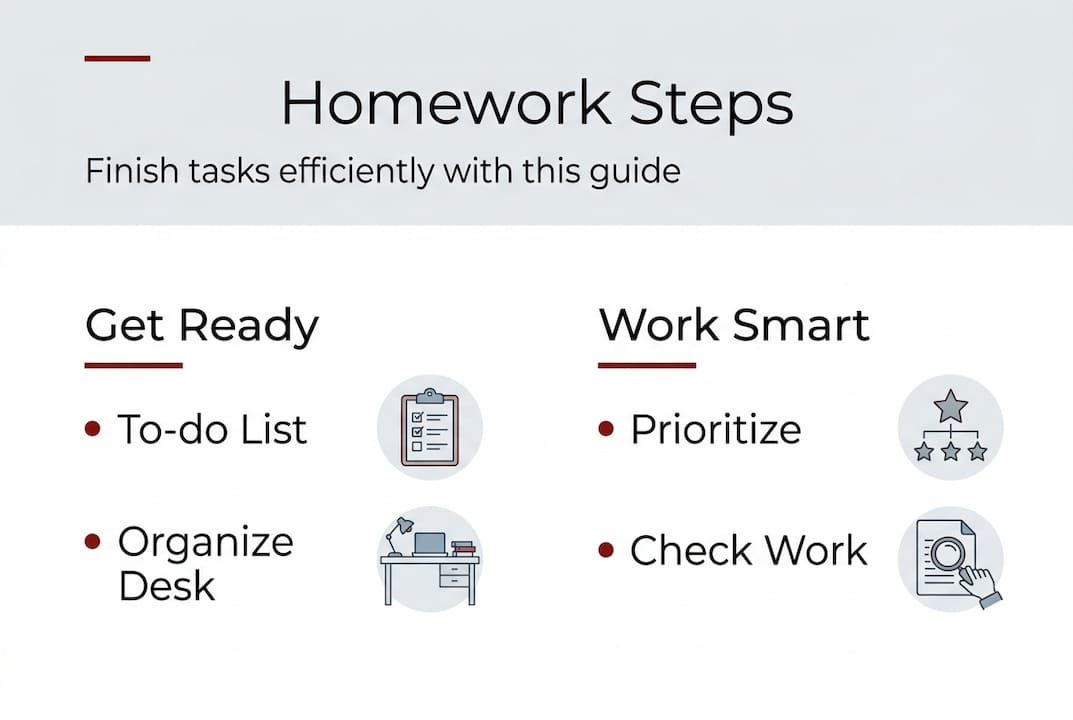
Before you open a single textbook, your setup matters more than you think. Organized workspaces boost productivity and cut down on the mental clutter that slows you down before you even begin. Think of preparation as the foundation. Skip it and everything else wobbles.
Start by gathering your materials so you're not hunting for a pencil mid-session. Here's what a solid homework kit looks like:
- Notebooks and loose-leaf paper for writing and scratch work
- Textbooks and handouts relevant to today's assignments
- A laptop or tablet for research, typing, or online submissions
- Highlighters and colored pens to mark key information
- A timer (your phone works fine) to structure your sessions
- Water and a light snack so hunger doesn't pull you away
Your workspace is just as important as your supplies. A quiet, clutter-free desk signals to your brain that it's time to focus. Sit away from the TV, silence non-essential notifications, and keep your phone face-down unless you need it for schoolwork.
Before diving in, write out a quick to-do list of every assignment you need to complete. Seeing it all on paper removes the mental load of trying to remember everything while you work. Then, set a clear intention: decide what you want to finish in this session and how long you'll spend on it.
| Workspace element | Why it matters |
|---|---|
| Quiet environment | Reduces cognitive interruptions |
| Organized desk | Speeds up material retrieval |
| Good lighting | Prevents eye strain and fatigue |
| Comfortable chair | Supports longer focus sessions |
| Phone on silent | Eliminates the biggest distraction |
Pro Tip: Spend the first five minutes of every homework session doing nothing but setting up your space and writing your to-do list. That small ritual trains your brain to shift into work mode faster every time.
Organize your assignments: Prioritization strategies
Once you're fully prepared, it's time to make sense of what's actually on your plate. Not all assignments are equal. Some are due tomorrow. Some count for 40% of your grade. Treating them the same is a mistake that costs students points and sleep.
Start by listing every assignment and estimating how long each one will take. Be honest with yourself. A five-paragraph essay is not a 20-minute task. Once you have your list, sort it using one of these two popular methods:
Method 1: Due date sorting Arrange tasks from soonest deadline to latest. Simple and effective for most students.
Method 2: Urgent-important matrix Divide tasks into four boxes: urgent and important, important but not urgent, urgent but not important, and neither. Focus on the first box first.
| Method | Best for | Drawback |
|---|---|---|
| Due date sorting | Students with many short deadlines | Ignores task difficulty |
| Urgent-important matrix | Complex, multi-subject workloads | Takes more time to set up |
| Time-estimate sorting | Heavy nights with mixed assignment types | Requires accurate time estimates |
Students who prioritize tasks consistently are more likely to meet deadlines and report lower stress levels. That's not just motivational talk. It's a measurable difference in academic outcomes.
Once you've sorted your assignments, build a realistic schedule for the session. Assign a start time and an end time for each task. Don't just think "I'll do math first." Write "Math: 4:00 to 4:45 PM."
Here's how to break large tasks into smaller steps:
- Identify the final output (a finished essay, a completed problem set)
- Work backward to list every step needed to reach that output
- Assign a time block to each step
- Treat each step as its own mini-task with a clear finish line
Pro Tip: If an assignment feels overwhelming, break it into three parts: start, middle, and end. Just commit to starting. Momentum builds once you're moving.
Follow the steps: A proven process for tackling homework
With your assignments prioritized, you're ready to work efficiently with these structured steps. The biggest mistake students make is diving into homework without a system. They jump between tasks, lose focus, and end up spending twice as long as necessary.

The most effective approach is working in focused intervals. The Pomodoro study technique uses 25-minute work blocks followed by a 5-minute break, which can increase study efficiency by up to 25%. Set a timer, commit to one task for that block, and stop when it rings.
Here's a step-by-step workflow you can apply to almost any assignment:
- Read the instructions fully before writing a single word or solving a single problem
- Gather all resources you'll need: notes, textbook pages, websites
- Complete the assignment in sections, not all at once
- Check your progress at the end of each section before moving forward
- Review the full assignment once you've finished everything
For specific assignment types, the process looks like this:
- Essay: Outline first, then write paragraph by paragraph, then revise
- Math problems: Read each problem fully, show your work, check answers after every five problems
- Science questions: Skim the relevant chapter section before answering, use diagrams if helpful
"The secret of getting ahead is getting started. The secret of getting started is breaking your complex, overwhelming tasks into small, manageable tasks, and then starting on the first one." — Mark Twain
Tracking your progress matters too. Cross off each step as you finish it. That small physical action releases a tiny hit of satisfaction that keeps you going. Celebrate finishing a section, not just the whole assignment.
Distraction is your biggest enemy during this phase. If a random thought pops up, jot it on a sticky note and return to it after your session. Don't chase it mid-task.
Review and refine: Checking your work for accuracy
After completing your assignments, take one last crucial step to guarantee your best results. Most students submit homework the second they finish the last question. That's leaving easy points on the table.
Reviewing homework before submission consistently boosts grades and reduces the need for corrections. A five-minute review can catch the kind of errors that cost you an entire letter grade.
Here's a quick checklist to run through before you submit anything:
- Did you answer every question or prompt?
- Does your work match the formatting requirements (font, spacing, length)?
- Are your calculations or facts double-checked?
- Is your name and the date on the assignment?
- Did you follow all specific instructions (show your work, cite sources, etc.)?
One of the most effective review tricks is reading your work aloud. Your ear catches errors your eye skips over. Awkward sentences, missing words, and repeated phrases all become obvious when you hear them.
Digital tools can also help. Grammar checkers catch surface-level writing errors, and calculator apps verify math answers. Use them as a second pass, not a replacement for your own review.
"Proofreading is the process of reading your work as a stranger would, catching what familiarity made you blind to."
Peer review is underrated. Ask a classmate, sibling, or parent to read your essay or check your answers. Fresh eyes spot problems you've become too close to see. Even a two-minute read-through from someone else adds real value.
Pro Tip: After getting graded work back, spend two minutes reviewing what you got wrong and why. Students who do this consistently make fewer of the same mistakes over time. Errors are data, not failures.
Our perspective: Why discipline beats talent in homework success
Here's something most homework guides won't say: talent is overrated. The students who consistently perform well academically are rarely the "smartest" ones in the room. They're the most organized. They show up with a system, follow it every day, and adjust when something isn't working.
Raw intelligence gets you nowhere if you're scrambling the night before every deadline. Discipline, on the other hand, compounds. A student who spends 45 focused minutes on homework every evening builds skills, retains information, and develops confidence that carries into every exam and project.
Most guides focus on tactics: timers, checklists, study methods. Those matter. But the psychological benefit of having a routine is what most people miss. When homework happens at the same time, in the same place, every day, your brain stops resisting it. It becomes automatic, like brushing your teeth.
Value the process as much as the grade. A student who learns how to work through difficult problems is building something that lasts far beyond the assignment. That's the real payoff of strong study habits.
Turn guidance into results with smart homework tools
You now have a complete system for tackling homework from start to finish. But knowing the steps and executing them under pressure are two different things. That's where smart tools make a real difference.
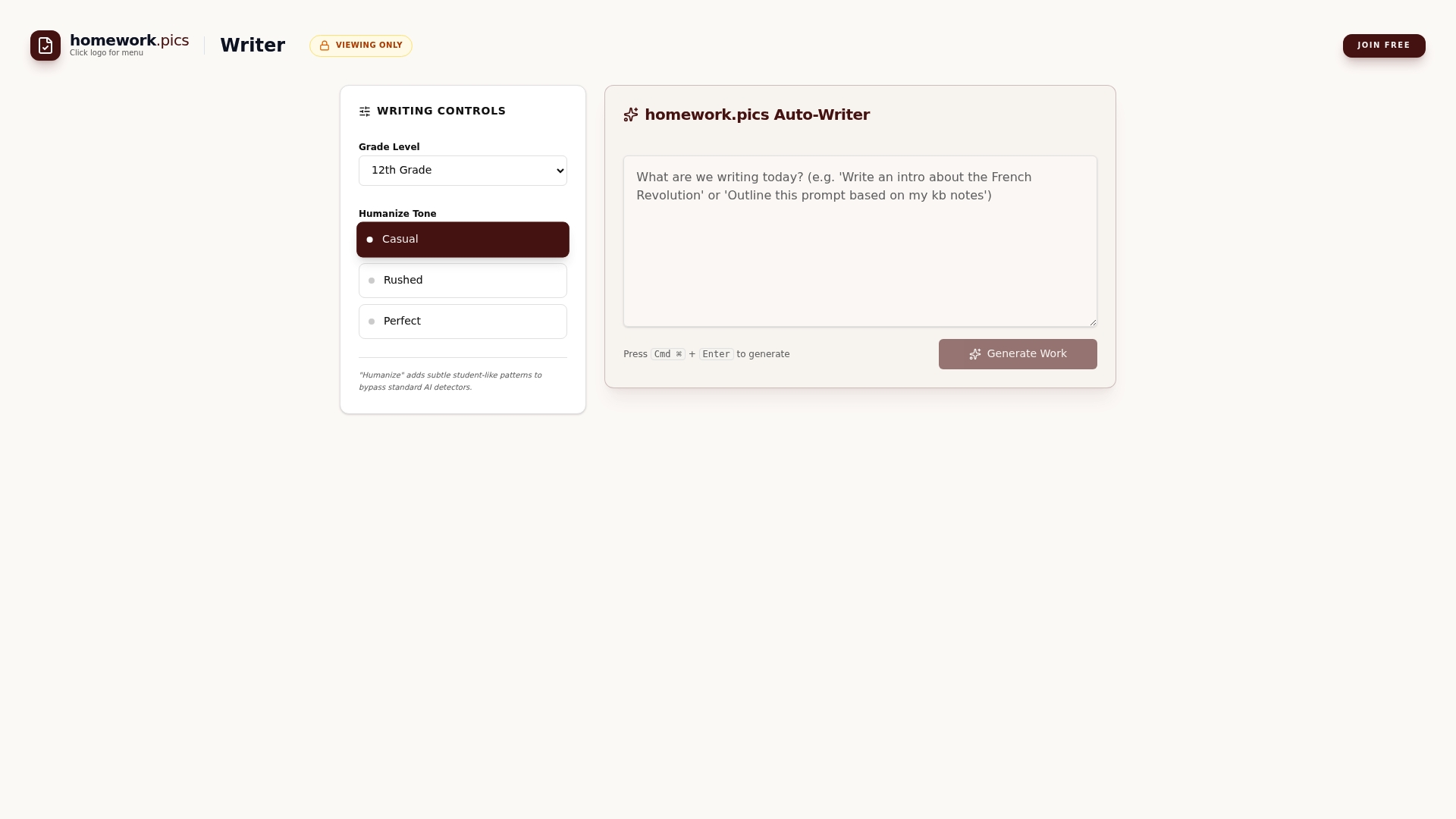
AI homework help at homework.pics gives you a platform that supports every stage of this process. From auto-writing tools that help you draft essays faster, to grade-level customization that matches your exact academic needs, it's built for students who want results without the burnout. Whether you're managing five subjects or just need a second opinion on your writing, homework.pics keeps you moving forward efficiently and confidently.
Frequently asked questions
What if I have too much homework to finish in one night?
Prioritize the most urgent assignments first, break each one into smaller steps, and communicate with your teacher about a deadline extension if the workload is genuinely unmanageable. Negotiating deadlines is a recognized strategy for handling heavy academic workloads.
How can I avoid getting distracted while doing homework?
Set up a quiet, clutter-free space before you begin and work in focused 25-minute intervals. A distraction-free environment combined with timed work intervals is one of the most effective focus strategies available to students.
What should I do if I make mistakes on my homework?
Review your work using a checklist, read it aloud to catch errors, and take note of the specific mistakes so you don't repeat them. Correcting homework errors before and after submission directly improves your long-term academic performance.
How do I motivate myself to start homework when I feel overwhelmed?
Start with the easiest task on your list to build momentum, set a small and specific goal for the first 15 minutes, and give yourself a real reward after hitting a milestone. Small achievable goals are proven to generate the motivation needed to tackle larger, more demanding tasks.